


What Powers Our Smart World?
Behind every responsive touchscreen, intelligent appliance, and autonomous vehicle is an invisible yet essential force. So, what truly powers our increasingly smart world? The answer lies not just in silicon chips, but in the sophisticated software architecture operating within them. This is the realm of embedded systems, where software is meticulously designed to perform dedicated functions, often with minimal human intervention. The core of this discipline is about building a robust and efficient digital nervous system for the devices that define modern life.
Creating this software foundation is a unique engineering challenge, governed by a strict set of constraints that differ significantly from traditional desktop or web development. These limitations are not just obstacles; they are the defining principles that shape every decision and give rise to specialized architectural solutions. Understanding these constraints is the first step to appreciating the elegance and ingenuity of embedded software design.
- Resource Scarcity: Embedded systems often operate with limited memory (RAM and ROM), minimal processing power, and tight energy budgets. Every line of code and every computational cycle matters.
- Real-Time Operation: Many systems, from anti-lock brakes to industrial controllers, must respond to events within a guaranteed timeframe. Failure to meet these deadlines can have critical consequences.
- Reliability and Safety: The software must be exceptionally stable and predictable, as it often controls physical machinery where failure is not an option. This demands rigorous testing and fault-tolerant design.
- Hardware Proximity: Developers work directly with hardware interfaces, managing peripherals, sensors, and actuators, requiring a deep understanding of the underlying electronics.
Navigating these challenges requires more than just good coding practices; it demands a strategic approach to system design. The following sections will explore the key architectural patterns and methodologies that provide the blueprint for building the reliable, efficient, and intelligent software that powers our connected devices.
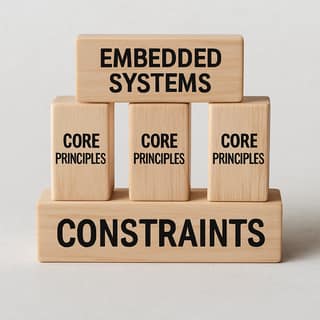
Core Principles: Building on a Foundation of Constraints
Unlike software for desktops or servers, the architectural philosophy that powers the smart world is not born from abundance, but from a foundation of strict constraints. Building robust embedded software requires a shift in perspective, where limitations are not obstacles but the very framework that shapes design. Understanding what core principles arise from this environment is key to appreciating the elegance and efficiency of these systems. These are not arbitrary rules, but direct responses to the physical and operational realities of the hardware.
- Resource-Aware Design: The most fundamental constraint is the scarcity of resources. With limited memory (RAM and Flash) and processing power, every byte and CPU cycle counts. This principle forces the use of efficient data structures, optimized algorithms, and often a choice between C/C++ for direct hardware control over higher-level languages. Architectural patterns must prioritize a minimal footprint.
- Deterministic and Real-Time Operation: Many embedded systems interact directly with the physical world and must respond within precise time windows. This leads to the core principle of determinism—the system’s behavior must be predictable. Architectural design often revolves around real-time operating systems (RTOS) or bare-metal schedulers to guarantee that critical tasks execute on time, every time. This is non-negotiable in applications like automotive control or medical devices.
- Power Efficiency as a Feature: For battery-powered or energy-harvesting devices, power consumption is a primary architectural driver. Building software involves more than just correct logic; it includes managing processor sleep states, optimizing peripheral usage, and choosing communication protocols that minimize energy cost. The goal is to spend as much time as possible in the lowest power state while still meeting performance requirements.
- Robustness and Safety: Embedded software is often deployed in environments where physical access is difficult or impossible, and failure can have severe consequences. This necessitates building for extreme reliability. Core architectural patterns like watchdogs, redundant processing, and fail-safe state management are not afterthoughts but are integrated from the project’s foundation to handle faults gracefully and ensure safe operating conditions.
Key Architectural Patterns and Operating Systems
Beyond the core principles, the practical task of building robust embedded software relies on a solid foundation of proven architectural patterns and a carefully selected operating system. These choices are not arbitrary; they are direct responses to the system’s unique constraints and functional requirements. They dictate what the software can do, how reliably it performs, and ultimately, how it powers a specific function in our smart world.
Common Architectural Patterns
Architectural patterns provide reusable, high-level solutions to common design problems, ensuring a system is maintainable, scalable, and resilient. In the embedded space, several patterns are prevalent:
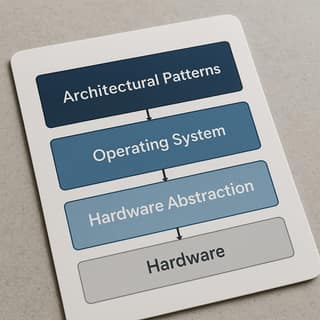
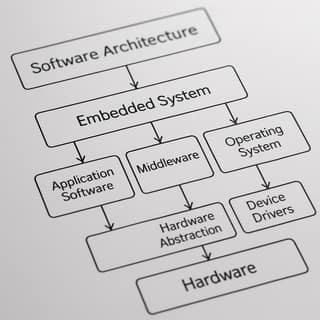
- Layered (or N-Tier) Architecture: This pattern separates concerns into distinct layers, such as a Hardware Abstraction Layer (HAL), a driver layer, a service layer, and an application layer. This separation simplifies development and testing, allowing teams to work on different layers independently and making the system more portable across different hardware.
- Event-Driven Architecture: Ideal for systems that must react to asynchronous inputs from sensors or user interfaces. In this model, components (or “listeners”) wait for specific events to occur and then execute a function. This is highly efficient for low-power devices, as the system can remain in a low-power state until an event “wakes” it.
- State Machine Pattern: Many embedded devices operate in a finite number of states (e.g., initializing, active, standby, error). A state machine provides a formal, predictable way to manage transitions between these states, reducing bugs and making complex logic easier to understand and verify.
The Role of the Operating System
The operating system (OS) is the software that manages all hardware resources and provides common services for applications. The choice of OS is one of the most critical decisions in embedded design, directly impacting real-time performance and reliability. For additional context and supporting details, see also More about Software Communications Architecture on Wikipedia.
- Real-Time Operating Systems (RTOS): An RTOS is the dominant choice for systems where timing is critical. Its primary feature is a deterministic scheduler that guarantees tasks will be executed within a predictable, defined timeframe. This is essential for applications like automotive braking systems or industrial controllers. Popular examples include FreeRTOS, Zephyr, and QNX.
- Embedded Linux: For more complex devices that require networking, advanced file systems, and rich user interfaces—like smart home hubs or in-vehicle infotainment systems—a tailored version of Linux is often used. While not inherently real-time (though extensions like PREEMPT_RT exist), it offers a vast ecosystem of drivers and libraries, accelerating the development of feature-rich applications.
- Bare-Metal / No OS: For the simplest microcontrollers with severe memory and processing constraints, developers may forgo an OS entirely. In this “bare-metal” approach, the application runs directly on the hardware, often using a simple “super loop” to check for and respond to events. This offers maximum control and minimal overhead but significantly increases development complexity.
The Advantages of a Well-Considered Design
Moving beyond the theoretical, the practical benefits of investing in a robust software architecture are substantial. While the initial effort of defining a system’s structure may seem to slow down the start of coding, it is the critical activity that lays the foundation for long-term success and viability. A well-considered design is not a luxury; it is a strategic imperative in the embedded world, where physical and performance constraints are unforgiving. The advantages manifest across the entire product lifecycle.
- Enhanced Maintainability and Scalability: A clear architecture, built upon sound principles, acts as a roadmap for the system. This clarity is invaluable when developers need to fix bugs or add features years after the initial release. When new functionality is required for the next generation of a smart device, a modular design allows for building new capabilities without destabilizing the core system. Adherence to established architectural patterns ensures that the system remains comprehensible and adaptable over time.
- Improved Reliability and Performance: Performance is not something that can be easily added later. A thoughtful design process addresses non-functional requirements—such as timing, memory usage, and power consumption—from the outset. It defines how components interact, how data flows, and how resources are managed by the operating system. This foresight is crucial for creating a reliable product that performs predictably under all conditions, which is exactly what a customer expects from the technology that powers their daily lives.
- Accelerated Development and Reduced Cost: A solid architectural blueprint reduces ambiguity and enables parallel development efforts. Teams can work on different components concurrently with confidence, knowing how their pieces will integrate into the whole. This structured approach minimises the risk of costly, late-stage redesigns that occur when a weak foundation can no longer support the system’s complexity. Furthermore, well-designed, reusable components can significantly shorten the development timeline for future products in the same family.

Infographic at a glance
Visual summary of the key points on this topic.

Overcoming Key Development Hurdles
Even with a solid grasp of fundamental design principles, the journey from concept to a functional embedded system is fraught with challenges. The very constraints that define this field create significant hurdles that engineering teams must overcome. Successfully navigating these obstacles is crucial for building the reliable devices that power our smart world.
Key hurdles often emerge at the intersection of hardware limitations and software ambitions. While a strong architectural foundation is essential, developers must contend with several practical difficulties:
- Navigating Severe Resource Constraints: The core challenge is often doing more with less. Limited memory (RAM and flash) and processing power dictate every decision. This goes beyond simply choosing lightweight architectural patterns; it involves meticulous optimization of the operating system, drivers, and application code. What powers the device is often a low-power microcontroller, forcing developers to constantly balance functionality against performance and energy consumption.
- Ensuring Real-Time Performance and Determinism: Many embedded systems must react to events in the physical world within strict time limits. Building a system that is not just fast, but predictably fast, is a major undertaking. This requires a deep understanding of the real-time operating system (RTOS) scheduler, interrupt handling, and potential sources of latency. The chosen architectural patterns must support, not hinder, these deterministic requirements.
- Managing Hardware-Software Integration Complexity: Unlike enterprise software, embedded systems have an intimate, inseparable relationship with their hardware. The software foundation is built directly upon silicon. This tight coupling makes debugging difficult, as problems can originate in the hardware, the software, or the subtle interactions between them. A simple bug might require an oscilloscope to diagnose, not just a software debugger.
- Designing for Long-Term Maintenance and Updatability: The lifecycle of an embedded device can span years or even decades. The initial architectural decisions have lasting consequences. Building a system that can be securely and reliably updated in the field is a significant hurdle. This requires careful planning for bootloaders, memory partitioning, and fail-safe mechanisms, ensuring the core operating principles of the device remain intact after an update.
The Evolution Towards Smarter, More Dynamic Systems
The established core principles of embedded design have provided a robust foundation for the devices that currently power our world. However, the industry is undergoing a significant shift. The focus is moving beyond static, single-function devices towards systems that are intelligent, adaptable, and interconnected. This evolution demands new architectural thinking, pushing the boundaries of traditional constraints and redefining what is possible on resource-limited hardware.
This forward momentum is driven by several key trends that are reshaping the software architecture of smart devices:
- Intelligence at the Edge: Instead of merely collecting data for the cloud, embedded systems are increasingly performing complex processing, like machine learning inference, directly on the device. This shift powers a new generation of responsive and autonomous products. It requires architectural patterns that can manage AI models, schedule intensive computational tasks, and interact with specialized hardware accelerators, all while working within the tight thermal and power constraints of the device.
- Dynamic Updates and Modularity: The “deploy-and-forget” model is becoming obsolete. Modern systems are built for evolution, with the ability to receive over-the-air (OTA) updates that fix bugs, patch security vulnerabilities, or even introduce new features. This necessitates a modular architecture. Technologies like containerization are being adapted for embedded operating systems, allowing independent components to be updated without risking the stability of the entire system. Building software in this way makes it more resilient and extends its useful lifespan.
- Hyper-Connectivity and Interoperability: A smart device rarely exists in isolation. It is a node in a larger ecosystem, from the smart home to the industrial factory floor. This requires a flexible foundation for communication, supporting multiple protocols and ensuring seamless interoperability. Consequently, security is no longer an add-on but a core architectural pillar, essential for building trust in an increasingly connected world.
Ultimately, the future of embedded architecture is dynamic. It involves blending time-tested principles with new patterns that embrace machine intelligence, modularity, and secure connectivity. The challenge for architects is to create a software foundation that is not only efficient and reliable today but also flexible enough to adapt to the demands of tomorrow.
Navigating Industry Standards and Compliance
In a smart world where embedded systems control critical functions, from medical devices to autonomous vehicles, the software that powers them is subject to rigorous scrutiny. Beyond the internal architectural principles that guide development, a formidable layer of external constraints exists in the form of industry standards and government regulations. Navigating this complex landscape is not an optional extra; it is a fundamental requirement for market access and, more importantly, for ensuring safety and reliability.
Understanding what these standards demand is a core part of the architect’s role. These regulations are not merely checklists to be addressed late in the development cycle. Instead, they must be integrated into the project’s foundation from the outset, influencing everything from the choice of operating system and development tools to the documentation process and testing methodologies. Adherence informs the selection of specific design patterns, often mandating fault tolerance, redundancy, and provable security measures. For many high-integrity systems, building a compliant product means demonstrating a clear, traceable line from a specific requirement down to the code that implements it.
Different industries have their own specific, non-negotiable standards. An architect must be fluent in the regulations relevant to their domain:
- Automotive: ISO 26262 defines functional safety for road vehicles, impacting everything from hardware design to software verification. AUTOSAR (Automotive Open System Architecture) provides a standardized framework to manage the growing complexity.
- Avionics: DO-178C is the primary standard for certifying software in airborne systems, with different levels of rigor depending on the potential consequences of a software failure.
- Medical Devices: IEC 62304 governs the software lifecycle processes, demanding meticulous risk management and validation to ensure patient safety.
- Industrial Control: IEC 61508 provides a broad framework for the functional safety of electrical and electronic systems, which is often adapted for specific sectors like process industries or machine control.
Ultimately, compliance is an integral part of the design process. It shapes the architectural choices, adds necessary constraints, and provides a framework for building robust and trustworthy systems. Failing to incorporate these core requirements from the beginning can lead to costly redesigns, certification failures, and significant delays in bringing a product to the market that our modern world increasingly relies on.
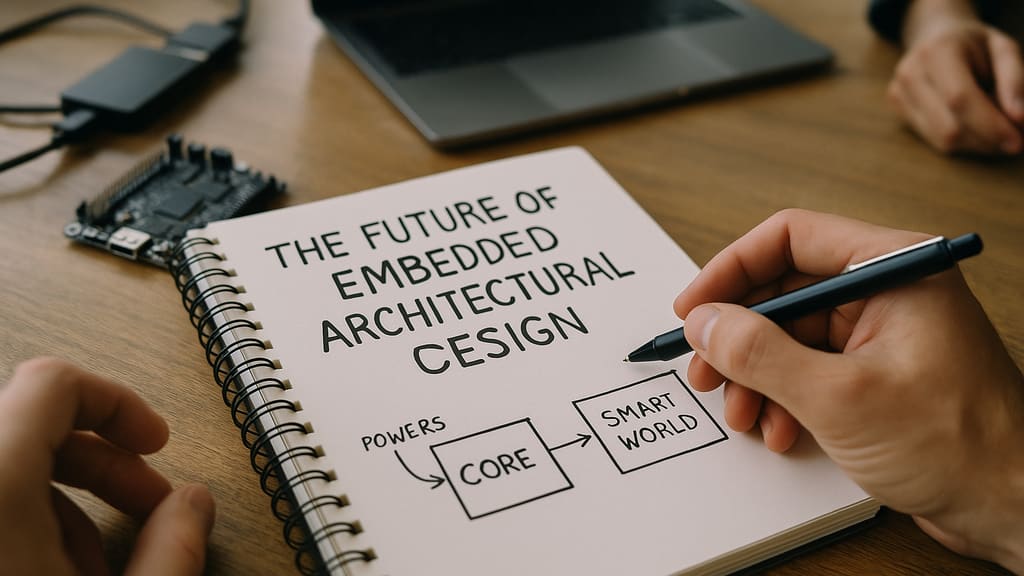
The Future of Embedded Architectural Design
Looking ahead, the very foundation of embedded architectural design is undergoing a profound transformation. The core principles of building robust systems within tight constraints remain, but the nature of those constraints and the goals of the systems themselves are evolving. The future is not merely about making devices work; it is about making them intelligent, adaptive, and securely interconnected. This shift redefines what powers our smart world, moving from static, task-oriented firmware to dynamic, data-driven software ecosystems.
The next wave of innovation will be driven by architectural patterns that embrace complexity and change. We are moving beyond traditional, monolithic designs toward more modular, service-oriented approaches, even on resource-constrained devices. The key is building a flexible foundation that can support a product’s entire lifecycle, from initial deployment to in-field updates and feature enhancements. This requires a fundamental rethinking of the relationship between hardware, the operating system, and the application layer.
Several key trends are shaping the future architectural landscape:
- Edge AI and Machine Learning: The most significant driver is the push to run AI models directly on embedded devices. This necessitates new architectural patterns for managing data pipelines, executing neural networks efficiently, and operating within strict power and thermal envelopes. The architect’s role expands to include data science principles, as the system’s core logic is no longer just coded but also trained.
- Software-Defined Functionality: In sectors like automotive and industrial IoT, hardware is becoming a commodity platform upon which value is created through software. Future architectural designs will prioritize abstraction layers and robust APIs, allowing for the dynamic configuration and updating of features. This makes the operating environment and its services the central hub of the system.
- Heterogeneous Computing: Systems are increasingly built with a mix of processing units—CPUs, GPUs, DSPs, and dedicated AI accelerators. A forward-looking architectural design must treat the system as a distributed network of specialized cores, creating patterns for efficiently scheduling tasks and managing data flow between them.
- Intrinsic Security and Digital Twins: Security can no longer be an afterthought. Future principles will involve a “security-first” foundation, with hardware roots of trust and secure-by-design software partitioning. This is complemented by the use of digital twins—complete virtual models of a system—which allow for exhaustive testing of architectural choices and security postures before a single piece of hardware is built.
Ultimately, the future of embedded architecture is about managing dynamic complexity. The challenge for designers is to select and adapt the core architectural patterns that provide a stable foundation for building the intelligent, evolving systems that will power the next generation of our smart world.
The Unseen Foundation of Modern Technology
When we ask what truly powers our increasingly smart world, the answer lies hidden in plain sight. It is not merely the silicon or the cloud, but the deliberate, disciplined software architecture embedded within every device. This is the unseen foundation upon which our connected reality is built. The journey through its design reveals that the most elegant solutions are born from the tightest constraints, transforming limitations into sources of efficiency and reliability.
The core principles of embedded design are not abstract ideals; they are the load-bearing pillars of this foundation. Every choice, from selecting specific architectural patterns to tailoring an operating system, is a calculated decision in building a system that is robust, secure, and efficient. This meticulous process ensures that a device—whether a medical implant or an automotive control unit—performs its function flawlessly for years, often under demanding conditions. The discipline required is immense, but it is this very rigor that guarantees the stability of the technology we depend on daily.
Ultimately, the software architecture of an embedded system is a testament to engineering foresight. It is the silent, invisible framework that enables functionality, ensures safety, and defines the user experience long before a single product is shipped. As technology continues to weave itself more deeply into the fabric of our lives, the strength and integrity of this foundational layer will become ever more critical, shaping the future of innovation itself.
FAQ
What distinguishes software architecture for embedded systems from that of general-purpose computing?
The primary distinction lies in the tight coupling with hardware and the presence of non-functional constraints. Unlike general-purpose software, which runs on standardized platforms with abundant resources, embedded software architecture is fundamentally shaped by the specific hardware it controls. This includes constraints like limited memory (RAM and ROM), low processing power, and strict power consumption budgets. Furthermore, many embedded systems have real-time requirements, demanding predictable and timely responses to external events, which is less common in desktop or web applications. The architecture must also prioritize reliability, safety, and security, as system failures can have severe consequences in domains like automotive, medical, or industrial control. These factors necessitate a design approach that is highly optimized, deterministic, and resilient from the ground up.
How do resource constraints like memory and processing power influence the choice of an architectural pattern?
Resource constraints are a dominant factor in selecting an architectural pattern for embedded systems. For instance, in a microcontroller with very limited RAM and flash memory, a complex, multi-layered architecture with a full-featured operating system might be infeasible. Instead, a simpler pattern like a bare-metal super-loop or a state machine might be chosen for its minimal overhead and predictable behavior. Limited processing power may favor an event-driven architecture to ensure the CPU is used efficiently and remains responsive, rather than a time-triggered or polling-based approach that could waste cycles. These constraints force engineers to make critical trade-offs between architectural elegance, modularity, and the practical realities of the hardware, directly impacting performance, cost, and power consumption of the final product.
Why is a layered architecture a common and effective choice for complex embedded systems?
A layered architecture is highly effective for managing complexity in sophisticated embedded systems. Its primary benefit is the separation of concerns, which promotes modularity and abstraction. Typically, it includes a Hardware Abstraction Layer (HAL) at the bottom, which isolates the upper software layers from the specific hardware details. Above this, a middleware layer might handle communication protocols, device drivers, and other system services. The top layer is the application logic, which focuses on the system’s core functionality. This separation simplifies development, as different teams can work on different layers concurrently. It also enhances portability and maintainability; the system can be migrated to new hardware by only modifying the HAL, and updates to one layer have minimal impact on others, reducing testing effort and risk.
What are the primary challenges in designing a software architecture for real-time embedded systems?
The foremost challenge in real-time embedded architecture is ensuring determinism and meeting strict timing constraints. The design must guarantee that critical tasks are completed within their specified deadlines, every time. This involves carefully managing task scheduling, preemption, and inter-task communication to avoid issues like priority inversion and unbounded latency. Another significant challenge is managing concurrency and shared resources. Multiple tasks often need to access the same peripherals or data, and the architecture must prevent race conditions and deadlocks without compromising system responsiveness. Verifying that the system will meet all its timing requirements under all possible conditions, including worst-case scenarios, is also a complex task that requires rigorous analysis, simulation, and testing, making the architectural design process exceptionally demanding.